What I'm most Excited about in Reason 14
Reason 14 is almost here, and I've been sitting with the beta for a while now. I went into it trying to be measured — new version numbers don't automatically mean better DAWs — but I came out the other side genuinely excited. Not hyped. Excited, which is different.
This isn't a comprehensive feature list. Reason Studios has published that themselves. What I want to share is the three things that actually changed how I'm working in the software — the stuff that made me sit back and think: yes, they finally figured that out.
Those three things are the Track Panel, the updated piano roll, and the RV-9 Reverb Station. Let me walk you through each one.
✅ For those of you eager to get started with Reason 14, I've put together a special offer to help you hit the ground running. ✅
The Track Panel — Reason Finally Gets Out of Its Own Way
If you've used Reason for any length of time, you know the dance. You're building a track, you're in the zone, and then you need to tweak a send level or check your signal chain — so you have to stop, switch views, navigate the Rack, find the device, make the change, and try to get back to where you were. Every time you do it, you lose a little thread of the idea you were chasing.
The Track Panel in Reason 14 kills that pattern dead. Select any track in the sequencer and the panel opens right there — signal chain, levels, sends, panning, all of it. You never have to leave the sequencer view. You stay in the creative headspace and the mix controls come to you.
Combined with Rack Per Track — which gives each track its own dedicated Rack column rather than everything living in one shared Rack view — navigating a complex session finally feels intuitive. The floating Rack window has also been redesigned for people who prefer a more plugin-style layout, so there's a path for every workflow style.
This is the kind of change that doesn't look dramatic in a feature announcement but completely transforms daily use. Anyone who mixes and produces inside Reason will feel this immediately.
The RV-9 Reverb Station — A Serious Upgrade to Reason's Best Reverb
✅ Confused by all the reason device? Click here to download this handy Reason Device Cheatsheet. ✅
The RV7000 has been Reason's flagship reverb for a long time, and it's genuinely good — deep, flexible, and capable of results that hold up in professional mixes. But Reason 14 replaces it with the RV-9 Reverb Station, and the difference is significant.
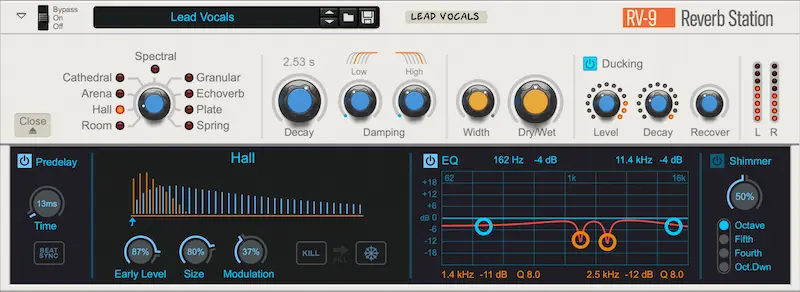
The RV-9 combines algorithmic and convolution techniques, giving you a full range of reverb types from realistic spaces to what Reason Studios calls "infinite, experimental soundscapes." There are nine algorithms in total, and they cover more ground than the RV7000 could: halls, plates, rooms, shimmer, ducking, granular processing, spectral modes.
Modern features like integrated EQ on the reverb tail and a built-in shimmer mode mean you can do things inside the RV-9 that would have previously required chaining multiple devices together. For anyone who uses reverb as a creative tool rather than just a space simulator, this is a real step up.
The Improved Piano Roll — The Complaint Is Finally Addressed
Reason's piano roll has been one of my longest-standing frustrations. For a DAW that's as deep and powerful as Reason is in other areas, the piano roll has always felt like it was left behind — a vestigial relic of an early 2000s DAW, limited in certain editing functions, and missing some of the ergonomic flow that competitors nailed years ago.
Reason 14 updates it meaningfully. The editing experience is noticeably smoother, and the improvements to MIDI programming speed up the kinds of tasks that used to require workarounds or extra clicks. Add Track Folders to the mix — which let you group and collapse channels to keep sessions organized — and the whole arrangement workflow starts to feel modern.
While it's not a ground-up rewrite of the piano roll, it is a huge improvement. If you came to Reason 14 specifically hoping for something as deep as what Ableton or Bitwig offer in MIDI editing, you may still want more. But as an upgrade over what was there before? It's substantial, and it's pointing in the right direction.
From a Frustrated Producer in a Ragtag Bedroom Studio to Major Placements on TV Earning $1,000s!
My name is Evan, and I've been making music since around 3rd grade. I'm from San Diego, California, but I've lived in Washington, DC for the last 20 years.
While I still have a full-time day job, I have created systems that have allowed me to produce dozens of songs a year in my spare time.
My songs have been on Netflix, TV shows like the 90 Day Fiance, an award-winning indie film, and NPR’s “All Thing Considered.” They've also been streamed millions of times.
In addition to being a music producer, I am passionate about teaching people how they can make professional-sounding music and earn money licensing it, all in their spare time.
Thousands of musicians, like yourself, have trusted me to guide their musical journey. My YouTube videos have been watched nearly a million times. And my story has been in Forbes, Side Hustle Nation, and the Side Hustle School.


EQ is the most essential tool you have for making music sound clean, clear, and professional. In this book you'll learn how to use the R.O.S.E. System, a simple 4-step EQ formula to help you master the world of EQ
