How to Sell Music on AudioJungle: A Composer's Step-by-Step Guide
AudioJungle is one of the world's largest stock music marketplace. Getting your music on it can mean access to millions of buyers — but the platform has some of the most frustrating submission requirements in the industry. This guide walks you through everything: account setup, the upload process, what actually gets accepted, and what you'll realistically earn.
Fair warning: I've been selling on AudioJungle since 2015 and my relationship with the platform is complicated. I'll give you the honest version.
Free 5-Day Course
New to Music Licensing?
Before diving into AudioJungle, grab the free Music Licensing Crash Course — 5 days of practical lessons that cover the full landscape of platforms, strategies, and how to actually build income from your music.
Get Instant Access (Free) →No spam. Unsubscribe any time.
Is AudioJungle Worth It for New Composers?
The honest answer: no, it shouldn't be your first platform.
AudioJungle's curation is strict, its upload process is complex, and new authors can only submit 2 tracks per month until they build a track record. If you start here with no experience, you'll spend a lot of time on rejected tracks and learn very slowly.
Moreover, AudioJungle currently has a hold on accepting new composers into its library. All the more reason to focus your energy elsewhere!
My recommendation: start with Pond5, build a catalog of 30–50 tracks, learn what sells, then bring your best, most polished work to AudioJungle. By that point you'll understand what AudioJungle's reviewers are looking for and waste far less time on rejections.
That said — once you're ready, AudioJungle's buyer volume is great. A track that performs well there can generate significant income. It's worth the effort for the right composer at the right stage.
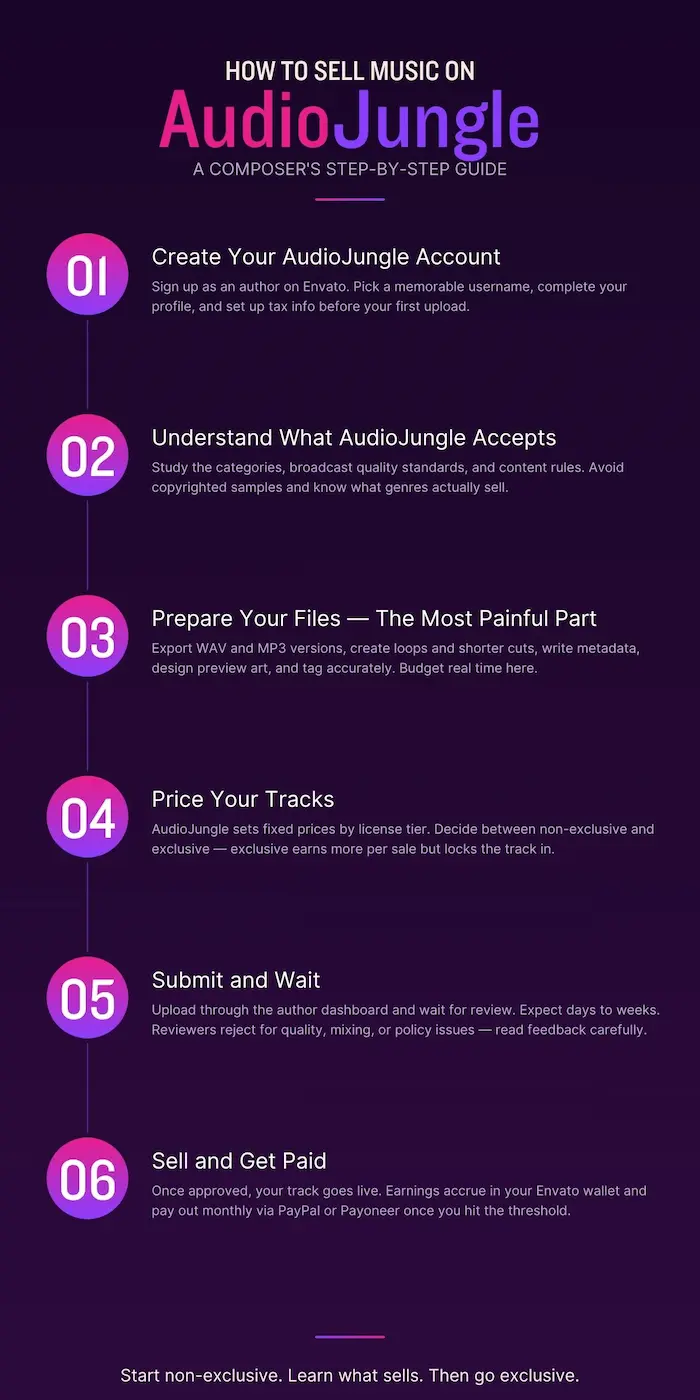
Step 1: Create Your AudioJungle Account
- Go to audiojungle.net and click "Start Selling"
- Create an Envato account (AudioJungle is part of Envato Market)
- Complete your author profile — a professional photo and bio improve buyer confidence
- Set up your payment method through Envato. Payments are made monthly for the prior month's sales
- Register with ASCAP or BMI before you start uploading. AudioJungle allows PRO registration, meaning you can collect performance royalties when your tracks are broadcast publicly
Step 2: Understand What AudioJungle Accepts
AudioJungle's review team is looking for a specific type of music. Understanding this before you submit will save you enormous amounts of time.
What gets accepted:
- Polished, professionally produced tracks with clean mixes
- Corporate and commercial styles — upbeat, positive, motivational
- Standard structures with clear beginnings and endings
- Tracks with multiple edits (full, 60-sec, 30-sec, 15-sec versions)
- Mainstream genre styles: pop, electronic, cinematic, acoustic
What typically gets rejected:
- Unusual or avant-garde arrangements
- Rough mixes or amateur production quality
- Tracks without multiple duration edits
- Very niche genres with limited commercial appeal
- Anything that sounds like it was produced quickly
I've had tracks rejected by AudioJungle that went on to sell dozens of times on Pond5. Their reviewers prioritize a specific commercial aesthetic over pure quality. Browse AudioJungle's bestsellers before submitting — spend 30 minutes studying what's at the top of their charts and you'll understand exactly what they want.
Step 3: Prepare Your Files — The Most Painful Part
This is where AudioJungle loses most new composers. The upload process is significantly more complex than any other platform.
For each track, you need to create:
- A watermarked preview MP3 — AudioJungle does NOT auto-generate this. You need to manually embed an audio watermark (a spoken "AudioJungle" overlay or similar) into your preview file. There are tools that can help, but it's still manual work.
- A ZIP file containing:
- Your full-quality WAV file(s)
- Your MP3 file(s)
- All edits of the track (full length, 60-second, 30-second, 15-second)
- Metadata — title, description, tags, BPM, key, instruments, mood
If you have a 5-edit track, expect to spend 20–30 minutes on file preparation alone — before knowing whether it will be accepted.
This overhead is why I strongly recommend having an established catalog and workflow before starting on AudioJungle. The opportunity cost of spending 30 minutes prepping a rejected track is significant when you could use that time making another song for Pond5.
Step 4: Price Your Tracks
AudioJungle lets you set your own prices. Standard License pricing ranges from $19 to $200+ — most composers price between $19–$49 for standard stock music.
Factors to consider:
- Genre: Corporate and background music typically prices lower ($19–$35). Cinematic and premium tracks can justify $50+.
- Production quality: If your track genuinely sounds like a $200 production, price it like one.
- Broadcast licenses: Set these significantly higher. A Music Broadcast & Film license should be $300–$500+, not $50.
See our full AudioJungle license types guide for how each license tier affects your royalties.
Step 5: Submit and Wait
After uploading your ZIP, watermarked preview, and metadata, your track enters the review queue. Expect to wait 2–4 weeks for a decision.
You'll receive an email with either an approval or rejection. Rejections rarely include specific feedback — you'll get a general category like "mixing and mastering" or "composition and arrangement." This vagueness is one of AudioJungle's most frequently criticized aspects.
New authors are limited to 2 submissions per month until they establish a successful track record. This limit increases as you build approved tracks and sales history.
What You'll Earn: Royalty Structure
As a non-exclusive author, AudioJungle pays ~36% of each sale. If you go exclusive, your rate scales with accumulated sales — starting at ~37% and climbing toward 70%+ as your sales history grows.
For most composers, non-exclusive is the right choice, especially early on. See our AudioJungle vs Pond5 comparison for a full breakdown of why exclusivity is usually not worth it for beginners.
How to Optimize Your AudioJungle Listings
Thumbnail image: Create a custom visual for each track. A distinctive waveform or mood-appropriate image makes your track stand out in search results.
Tags: Use all available tag slots. Think like a buyer: what words would they type? Include genre, instruments, mood, tempo, and use case (corporate video, YouTube, podcast, etc.).
Description: Write a compelling 3–5 sentence description. This is indexed by AudioJungle's search and shows up when buyers preview your track.
Author page: Unlike Pond5, AudioJungle lets you customize your author page and build a brand. Return customers are valuable — make your page worth visiting.
FAQ: Selling Music on AudioJungle
How long does AudioJungle review take?
Typically 2–4 weeks. You'll receive an email when a decision is made.
Can I sell the same music on Pond5 and AudioJungle?
Yes, as long as you use non-exclusive licensing on AudioJungle.
Why do so many tracks get rejected?
AudioJungle's reviewers apply a strict commercial aesthetic standard. Good production quality is necessary but not sufficient — they're looking for a specific polished, mainstream commercial sound.
How much can I realistically earn on AudioJungle?
This varies enormously. New composers with a small catalog earn very little. Established authors with 100+ accepted tracks in popular categories can earn $500–$2,000+/month. See our post on how much stock music composers make for realistic benchmarks.
Free 5-Day Course
Learn the Full Music Licensing Playbook — Free
The Music Licensing Crash Course covers platform strategy, catalog building, and how to maximize your earnings across AudioJungle, Pond5, and beyond. Five days. Completely free.
Start the Free Course →No spam. Unsubscribe any time.
For the complete picture on building income from stock music, read our full guide to making money licensing stock music.
From a Frustrated Producer in a Ragtag Bedroom Studio to Major Placements on TV Earning $1,000s!
My name is Evan, and I've been making music since around 3rd grade. I'm from San Diego, California, but I've lived in Washington, DC for the last 20 years.
While I still have a full-time day job, I have created systems that have allowed me to produce dozens of songs a year in my spare time.
My songs have been on Netflix, TV shows like the 90 Day Fiance, an award-winning indie film, and NPR’s “All Thing Considered.” They've also been streamed millions of times.
In addition to being a music producer, I am passionate about teaching people how they can make professional-sounding music and earn money licensing it, all in their spare time.
Thousands of musicians, like yourself, have trusted me to guide their musical journey. My YouTube videos have been watched nearly a million times. And my story has been in Forbes, Side Hustle Nation, and the Side Hustle School.


EQ is the most essential tool you have for making music sound clean, clear, and professional. In this book you'll learn how to use the R.O.S.E. System, a simple 4-step EQ formula to help you master the world of EQ
