How to Make Money Licensing Stock Music: The Complete Guide (2026)
I wrote my first stock music track in 2015. It was a mediocre chill dub loop, and it sold on AudioJungle for $19. I got about $6.85 of that.
That small, underwhelming transaction changed the trajectory of my music career.
Over the next several years, I built a catalog across multiple platforms, started earning consistent passive income from my music, and eventually built this entire site to document what I learned. I've made mistakes — including losing $1,600 on a bad licensing decision — and I've had real wins. This guide covers all of it.
If you want to know how to make money licensing stock music, this is the most honest, experience-based answer I can give you.
Free 5-Day Course
Learn to Make Money Licensing Your Music
This free 5-day crash course shows you exactly how to launch a music licensing side hustle — so you can finally get paid for your music.
Get Instant Access (Free) →No spam. Unsubscribe any time.
What Is Stock Music Licensing?
Stock music licensing is the process of uploading your original compositions to online libraries where content creators — YouTubers, filmmakers, podcasters, advertisers, game developers — can pay to use your music in their projects.
When someone licenses your track, you receive a royalty. The buyer gets the right to use your music without hiring a composer or negotiating individual rights. It's a win for both sides.
This is different from sync licensing (where your music is placed in a specific TV show or film), though the lines blur. Stock music libraries increasingly handle both.
The key appeal for composers: once you upload a track, it can earn money indefinitely without additional work. That's the passive income model that makes stock music worth building a catalog for.
And in 2025 and 2026 as the AI boom continues to explode, the songs in the libraries are being used to train new models. I have made thousands of dollars from these training fees.
The Two Business Models: Exclusive vs Non-Exclusive
Before choosing platforms, you need to understand the core decision every stock music composer faces.
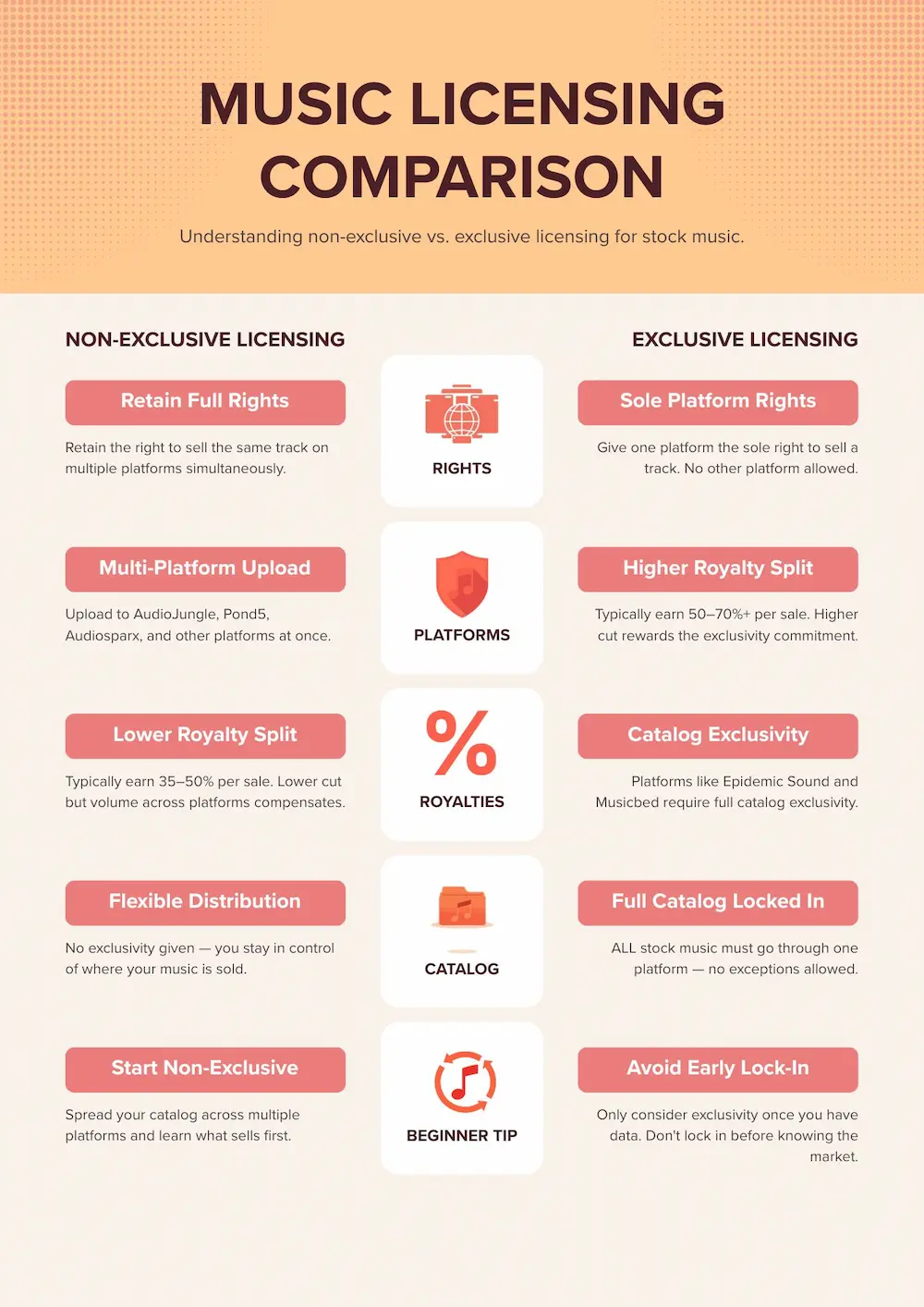
Non-exclusive licensing means you retain the right to sell the same track on multiple platforms simultaneously. You upload to AudioJungle, Pond5, Audiosparx, and wherever else you like. Each platform pays a lower percentage (typically 35–50%) because you're not giving them exclusivity.
Exclusive licensing means you give one platform the sole right to sell a track. In return, they typically pay a higher percentage (50–70%+). Some platforms like Epidemic Sound and Musicbed require full catalog exclusivity — meaning ALL your stock music goes through them.
My recommendation for beginners: Start non-exclusive. Spread your catalog across multiple platforms, learn what sells, and only consider exclusivity once you have enough data to know it's worth it. Locking yourself into one platform before you understand the market is a mistake I see beginners make constantly.
Which Platforms Should You Use?
There are dozens of stock music platforms. Here are the ones worth your time, based on my experience:
For Beginners (Non-Exclusive)
Pond5 is my top recommendation for most composers starting out. You set your own prices, keep about 30% of each sale, and the platform doesn't have the brutal curation process that AudioJungle does. The buyer base is large and diverse. Read my full Pond5 review and guide on how to make money on Pond5.
AudioJungle has the largest buyer base in the world for stock music, but a frustrating upload process and a curation team that rejects a surprising amount of good music. The royalty rate for non-exclusive authors is ~36%. Worth being on, but I wouldn't make it your primary platform. See my full AudioJungle review and guide to selling music on AudioJungle.
Audiosparx is a smaller platform with a more music-industry-friendly approach — they help connect composers with sync placements, not just one-off license sales. Lower volume than Pond5 or AudioJungle, but a different type of buyer. My Audiosparx review covers whether it's worth your time. Audiosparx has also been really successful at finding lucrative opportunities for AI training.
For Established Composers (Consider Exclusivity)
Musicbed is one of the most prestigious sync licensing platforms, used heavily by professional video production companies and brands. They're selective — you need a strong, professional catalog to get accepted — but the per-placement fees are significantly higher than most stock platforms.
Artlist operates on an annual subscription model where buyers pay a flat fee for unlimited music access. Composers earn based on usage data. The rates per-stream are low but the volume is high. Exclusivity is required.
Not sure which platform is right for you? Read our AudioJungle vs Pond5 comparison and our full guide to music libraries accepting submissions.
Realistic Income Expectations
I'm going to give you the honest answer that most "make money with music" articles avoid.
In year one: Expect almost nothing. You're building a catalog, learning what sells, and getting rejected by platforms. If you earn $100–$200 in your first year, that's a reasonable outcome.
In years two and three: With consistent uploading and a catalog of 50–100 tracks, you can realistically earn $200–$400/month across multiple platforms including quarterly royalty payments from your publishing society. Some composers do significantly better; most do less.
After five years: Composers with large, well-curated catalogs (200+ tracks) across multiple platforms can earn $1,000/month in passive income, including quarterly royalty payments from your publishing society. Some earn substantially more, particularly those who also pursue sync placements.
The compounding effect is real: each track you add earns alongside every track you've already uploaded. A catalog of 300 tracks earns far more than 3× a catalog of 100 tracks, because the best tracks keep accumulating sales while you continue adding more.
Use our stock music earnings calculator to model your own income potential based on catalog size and platform mix.
What Types of Music Sell Best
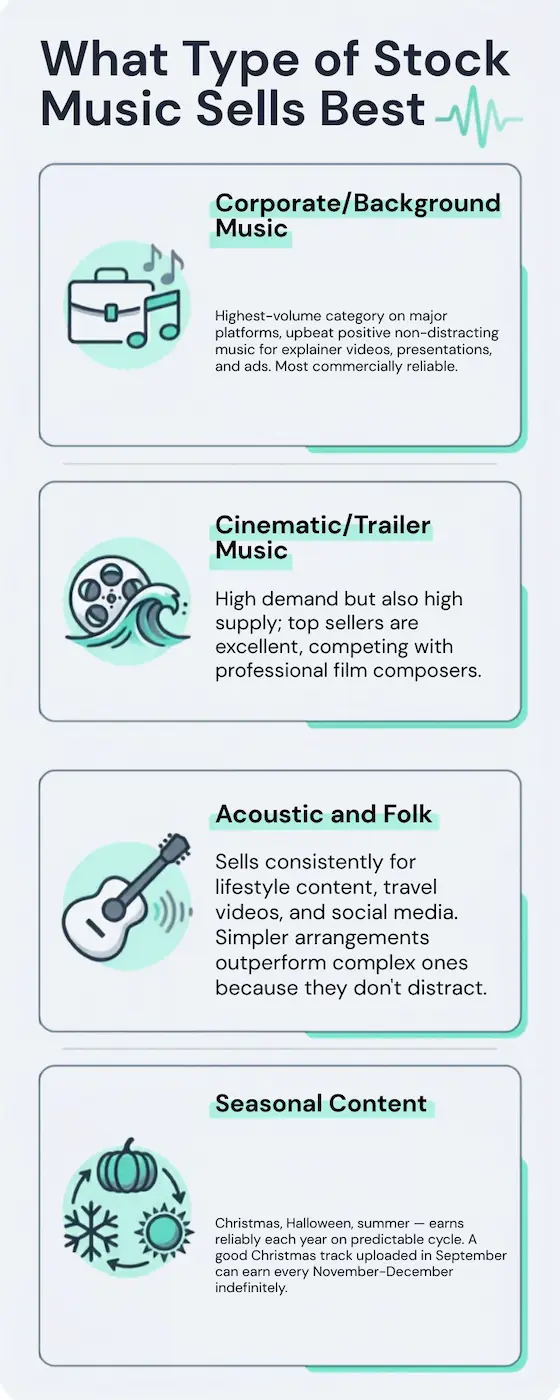
Corporate/background music is the highest-volume category on every major platform. Think: upbeat, positive, non-distracting music for explainer videos, presentations, and ads. It's not the most creatively fulfilling music to write, but it's the most commercially reliable.
Cinematic/trailer music has high demand but also high supply. The top sellers in this category are truly excellent. If this is your strength, lean in — but know you're competing with professional film composers.
Acoustic and folk sells consistently, especially for lifestyle content, travel videos, and social media. Simpler arrangements often outperform complex ones because they don't distract from the video.
Seasonal content (Christmas, Halloween, summer) earns reliably each year on a predictable cycle. A good Christmas track uploaded in September can earn every November–December indefinitely.
How to Get Your Music Accepted
Production quality first. Your mix and master need to sound professional. A brilliant composition with a muddy mix will be rejected. This is where investing in good monitoring, EQ skills, and mastering pays off directly.
Structure matters. Most stock music buyers want tracks that are easy to cut to picture — clear sections, predictable arrangement, a definitive beginning and end.
Provide edits. A 2-minute full version plus 60-second, 30-second, and 15-second edits dramatically increases your chances of a sale.
Keywords and metadata are critical. A great track with poor keywords is invisible. Spend as much time on your metadata as you do on your mix.
For detailed guidance, read our guide on music libraries accepting submissions and 5 things to do before submitting to a music library.
Understanding Licensing Types
The most common license types you'll encounter:
- Standard/Royalty-Free License: The buyer can use the track in one project, typically non-broadcast. Most common on AudioJungle and Pond5.
- Extended/Broadcast License: Covers broadcast use (TV, film, radio). Significantly higher price — often 10–20× the standard license fee.
- YouTube License: Covers YouTube use including Content ID protection.
- Podcast License: Covers ongoing use in a podcast series.
See our detailed guide to AudioJungle's license types for a full breakdown of what each covers.
Building a Catalog That Earns Passively
Set a consistent upload cadence. Two to four tracks per month, consistently, beats sporadic bursts of ten tracks followed by months of nothing.
Track what sells. After six months, you'll have data on which tracks perform. Write more of what sells.
Diversify platforms. Don't rely on one library for all your income. Spreading across 3–5 platforms protects your income.
Register with a PRO. If you're in the US, register with ASCAP or BMI. Performance royalties from broadcast use are money you're otherwise leaving on the table.
Think long-term. The first year is planting seeds. The third year is when you start harvesting.
For a deeper look at strategy, read our guide on building a stock music license strategy.
Your Next Steps
- Pick one platform to start. I recommend Pond5 for most beginners.
- Upload your first 10 tracks. Get them up, get your metadata right, and see what happens.
- Add a second platform after 30 days. AudioJungle is the natural second stop.
- Track your earnings monthly using the earnings calculator.
- Keep uploading. Consistency beats talent in this market.
Free 5-Day Course
Ready to Get Paid for Your Music?
Join the free Music Licensing Crash Course — 5 days of practical lessons that show you exactly how to launch a licensing side hustle and start building passive income from your catalog.
Start the Free Course →No spam. Unsubscribe any time.
From a Frustrated Producer in a Ragtag Bedroom Studio to Major Placements on TV Earning $1,000s!
My name is Evan, and I've been making music since around 3rd grade. I'm from San Diego, California, but I've lived in Washington, DC for the last 20 years.
While I still have a full-time day job, I have created systems that have allowed me to produce dozens of songs a year in my spare time.
My songs have been on Netflix, TV shows like the 90 Day Fiance, an award-winning indie film, and NPR’s “All Thing Considered.” They've also been streamed millions of times.
In addition to being a music producer, I am passionate about teaching people how they can make professional-sounding music and earn money licensing it, all in their spare time.
Thousands of musicians, like yourself, have trusted me to guide their musical journey. My YouTube videos have been watched nearly a million times. And my story has been in Forbes, Side Hustle Nation, and the Side Hustle School.


EQ is the most essential tool you have for making music sound clean, clear, and professional. In this book you'll learn how to use the R.O.S.E. System, a simple 4-step EQ formula to help you master the world of EQ
