How to EQ Woodwinds
Woodwinds, similar to the human voice, are very dynamic and have a large frequency range within which they live. An oboe is very different from a flute, which is very different from a saxophone, and so on.
However, the beauty of most woodwind instruments is that they have limited frequency ranges. If you have the chance to EQ each woodwind instrument separately, choosing the frequency range for them to live in is quite easy.
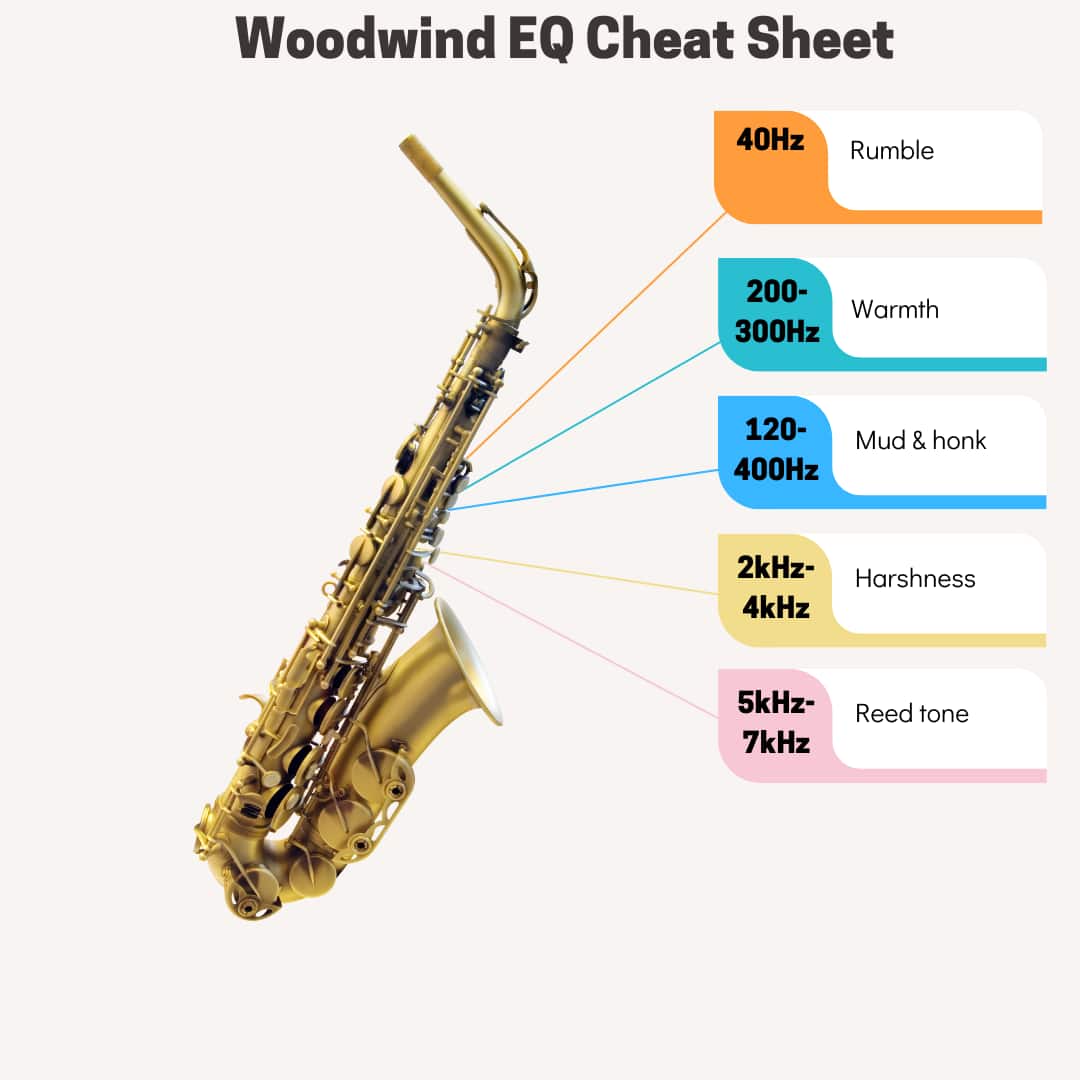
At the end of this article, you'll find a free Woodwind EQ Cheat Sheet that you can right-click to download!
Note: this article may contain affiliate links, which mean that I receive a commission for any purchases you make, at no added cost to you.
Free Crash Course: How to Mix with EQ
Most mixes don't fall apart because of bad plugins. They fall apart because of bad EQ decisions. I put together a free crash course that walks you through my whole EQ process, based on my book How to Mix with EQ. Get the free course here.
What Makes EQing Woodwinds Challenging
The major challenge when EQing woodwinds is that they are not as resilient to heavy EQ changes as their brass cousins. It is important to be delicate when EQing woodwind instruments so that you don’t remove necessary tonal characteristics. In some cases, using dynamic EQ can be a better choice for these dynamic instruments.
How To EQ Flute
The flute is a high-end instrument that often requires very little low-end information. Use a high-pass filter to get rid of any low-end noise and rumble. You can often high-pass up to around 200Hz–250Hz without taking away from the natural sound (piccolo flute: 500Hz–600Hz).

Check for mud around 250Hz–400Hz. The soft or percussive sound of a flute lies around 2kHz–4kHz, which can push the flute forward when it should be the focus. For air and brightness, use a high shelf to boost around 10kHz–12kHz.

How To EQ Saxophone
The saxophone operates in the mid-range for the most part, though it depends on the type. High-pass up to about 100Hz. Mud and honk typically appear anywhere from 120Hz–400Hz depending on the type of sax (baritone mud is lower, soprano mud is higher). A unique squawk in the 1kHz–2kHz range can cause harsh recordings — cut carefully here. Reed noise lives around 5kHz–7kHz — cut with a narrow Q if it's undesirable.

How To EQ Oboe
The majority of oboe fundamentals live in the 200Hz–2kHz range. High-pass below 200Hz to get rid of unnecessary information. Mud typically appears between 200Hz–400Hz. If your oboe sounds harsh, cut anywhere from 2kHz–4kHz.

How To EQ Clarinet
Be very cautious with heavy EQ on the clarinet. High-pass anywhere from 120–140Hz to clean up low-end rumble. Mud typically lives from 140Hz–300Hz — use a narrow Q to avoid removing too much body. Clarinet extends well into the high range, so feel free to accentuate highs with a high shelf boost from 8kHz and up.

How To EQ Bassoon
Take the same caution as with clarinet, but the bassoon holds down the low-end better. Start by high-passing anywhere from 50Hz–60Hz. Don’t use a steep dB per octave setting or you risk low-end resonance. Mud often builds up between 60Hz–250Hz. The bassoon often doesn’t need tons of high-end — low-pass down to about 6kHz to clear up air noise and make room for upper mid-range instruments.

More EQ Guides
- How to Mix with EQ
- Tips for EQing piano
- Electric guitar EQ tips
- How to EQ acoustic guitar
- How to EQ bass guitar
- How to EQ drums
- How to EQ vocals
- How to EQ strings
- How to EQ Percussion
Woodwind recordings are highly valued by video producers and licensing buyers — they're consistently in demand on stock music platforms. If you're recording and mixing woodwinds, those sessions could be building passive income. See our guide on how to make money on Pond5 to learn how to get your woodwind recordings in front of buyers — and our complete guide to making money licensing stock music for the full strategy.
From a Frustrated Producer in a Ragtag Bedroom Studio to Major Placements on TV Earning $1,000s!
My name is Evan, and I've been making music since around 3rd grade. I'm from San Diego, California, but I've lived in Washington, DC for the last 20 years.
While I still have a full-time day job, I have created systems that have allowed me to produce dozens of songs a year in my spare time.
My songs have been on Netflix, TV shows like the 90 Day Fiance, an award-winning indie film, and NPR’s “All Thing Considered.” They've also been streamed millions of times.
In addition to being a music producer, I am passionate about teaching people how they can make professional-sounding music and earn money licensing it, all in their spare time.
Thousands of musicians, like yourself, have trusted me to guide their musical journey. My YouTube videos have been watched nearly a million times. And my story has been in Forbes, Side Hustle Nation, and the Side Hustle School.


EQ is the most essential tool you have for making music sound clean, clear, and professional. In this book you'll learn how to use the R.O.S.E. System, a simple 4-step EQ formula to help you master the world of EQ
