How to EQ Strings
One of my absolute favorite instruments for adding the final touches to my productions is strings. However, getting strings to fit well in a mix, let alone with each other, can be a bit of a challenge.
And, of course, the way in which we EQ strings can change drastically from one mix to the next.
In a classical mix, for example, you might want to leave everything sounding as natural as possible, focusing more on the placement of strings with pan knobs and the tone of the room during the recording phase. However, in a pop mix, strings might not need to take up a fair portion of the frequency spectrum.
In this article, we’re going to dive in and give you the fundamental frequencies to look for when EQing strings in your mix and give you some of my best tips from my book How to Mix with EQ.
Note: this article may contain affiliate links, which mean that I receive a commission for any purchases you make, at no added cost to you.
Free Crash Course: How to Mix with EQ
Most mixes don't fall apart because of bad plugins. They fall apart because of bad EQ decisions. I put together a free crash course that walks you through my whole EQ process, based on my book How to Mix with EQ. Get the free course here.
What Makes EQing Strings Challenging?
From top to bottom, strings have A LOT of frequency content. In higher strings, such as violin and viola, you often get tons of top-end that can stick out of a mix if you’re not careful. With cellos and bass, you get tons of boomy, low-end frequency content that can muddy up your mixes and take away precious clarity.
In essence, you’ll have to mix different types of strings differently, scooping the mud out of low-end heavy strings while retaining warmth and getting rid of harsh high frequencies in high-end strings while retaining a sense of brilliance.
How to EQ String Bass
Bass frequencies require a fair amount of power. If you’re unable to tame them, they can eat up the headroom in your track. Plus, untamed bass frequencies can make your mixes sound muddy and disproportionate.
For EQ string bass, the most important frequency range is from 40 to 200 Hz. You can often roll off the low-end below 32Hz without causing any problems. If you need to increase or decrease the “weighty” part of the bass, look to boost or cut in the 80 to 100Hz range. If your bass is sounding a bit boomy, consider cutting between 100 to 150Hz. If your bass is lacking warmth, add a slight, wide boost anywhere from 100 to 300Hz.
If your string bass needs a bit more attack, look in the 500Hz to 1.5kHz region.
How to EQ Cello
Starting with the low-end, you’ll typically want to get rid of any rumble that sits from 0 to 80Hz. When checking for mud, look between 200 and 300Hz. For warmth and fullness, look in the 400 to 600Hz range. If your cello needs a bit of added presence and definition, look between 6 to 8kHz. I’ll sometimes low-pass down to around 14-15kHz to get rid of top-end harshness.
How to EQ Viola
In most mixes, viola won’t need tons of low-end. You can typically high-pass up to about 100Hz without ruining the integrity of the instrument. If your viola is in a mix with other string instruments, check for mud in the 150 to 240Hz range. To add some bow noise, boost around 2.4 to 4kHz. To enhance the attack, boost anywhere from 500-1kHz.

How to EQ Violin
You can treat violins the same way as violas in many instances. You often don’t need a lot of low-end — most of the frequency content below 100Hz is just rumble. In a dense mix, tame the low-mids with a cut anywhere from 100-250Hz. For a solo violin, boost around 200-350Hz for fullness. Boost anywhere from 2.4kHz to 7kHz to get a bit of added string noise, or even 7-10kHz if you want a bit more scratchiness.
How to EQ String Section
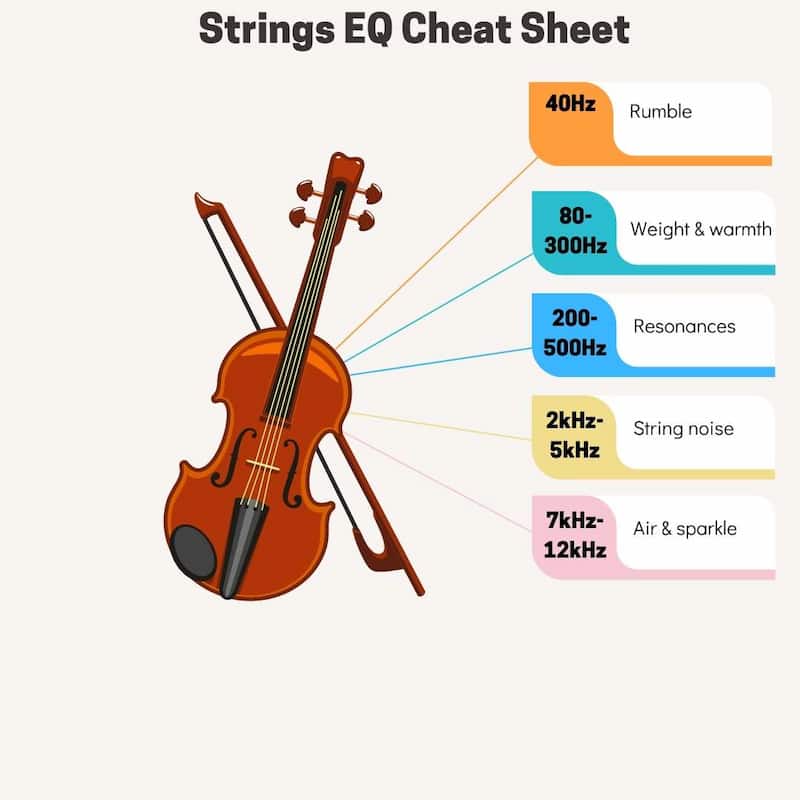
If you don’t have the luxury of EQing individual string instruments, be a bit more cautious with your EQ approach. High-pass up to 40Hz for string sections. Find weight and warmth from 80 to 300Hz, with small cuts between 200 to 500Hz to get rid of resonant peaks. Attack usually lies in the 500Hz to 1kHz range. Add a high-shelf above anywhere from 7kHz to 12kHz for a bit of added air and sparkle.
More EQ Guides
- How to Mix with EQ
- Tips for EQing piano
- Electric guitar EQ tips
- How to EQ acoustic guitar
- How to EQ bass guitar
- How to EQ drums
- How to EQ vocals
- How to EQ woodwinds
- How to EQ Percussion
One more thing worth knowing: string instruments are among the best-selling categories on stock music platforms like Pond5 and AudioJungle. If you're recording and mixing strings, those sessions could be building passive income. See our guide on how to make money on Pond5 to learn how to get your string recordings in front of buyers — and our complete guide to making money licensing stock music for the full picture.
From a Frustrated Producer in a Ragtag Bedroom Studio to Major Placements on TV Earning $1,000s!
My name is Evan, and I've been making music since around 3rd grade. I'm from San Diego, California, but I've lived in Washington, DC for the last 20 years.
While I still have a full-time day job, I have created systems that have allowed me to produce dozens of songs a year in my spare time.
My songs have been on Netflix, TV shows like the 90 Day Fiance, an award-winning indie film, and NPR’s “All Thing Considered.” They've also been streamed millions of times.
In addition to being a music producer, I am passionate about teaching people how they can make professional-sounding music and earn money licensing it, all in their spare time.
Thousands of musicians, like yourself, have trusted me to guide their musical journey. My YouTube videos have been watched nearly a million times. And my story has been in Forbes, Side Hustle Nation, and the Side Hustle School.


EQ is the most essential tool you have for making music sound clean, clear, and professional. In this book you'll learn how to use the R.O.S.E. System, a simple 4-step EQ formula to help you master the world of EQ
