How Much Do Stock Music Composers Make? Realistic Income Expectations
Most articles about stock music income either wildly oversell it ("make $10,000 a month passively!") or dismiss it entirely ("stock music doesn't pay anything"). The truth, as usual, is more nuanced and more interesting than either extreme.
I've been licensing stock music since 2015. I've published my actual earnings reports on this site going back to 2016. This post gives you the honest numbers — what composers at different stages actually earn, what factors drive the difference, and what timeline is realistic for building meaningful income.
Free 5-Day Course
Ready to Start Building Your Own Stock Music Income?
The free Music Licensing Crash Course shows you exactly how to get started — from choosing platforms to uploading your first tracks and building a catalog that earns passively.
Get Instant Access (Free) →No spam. Unsubscribe any time.
Income by Stage: What to Realistically Expect
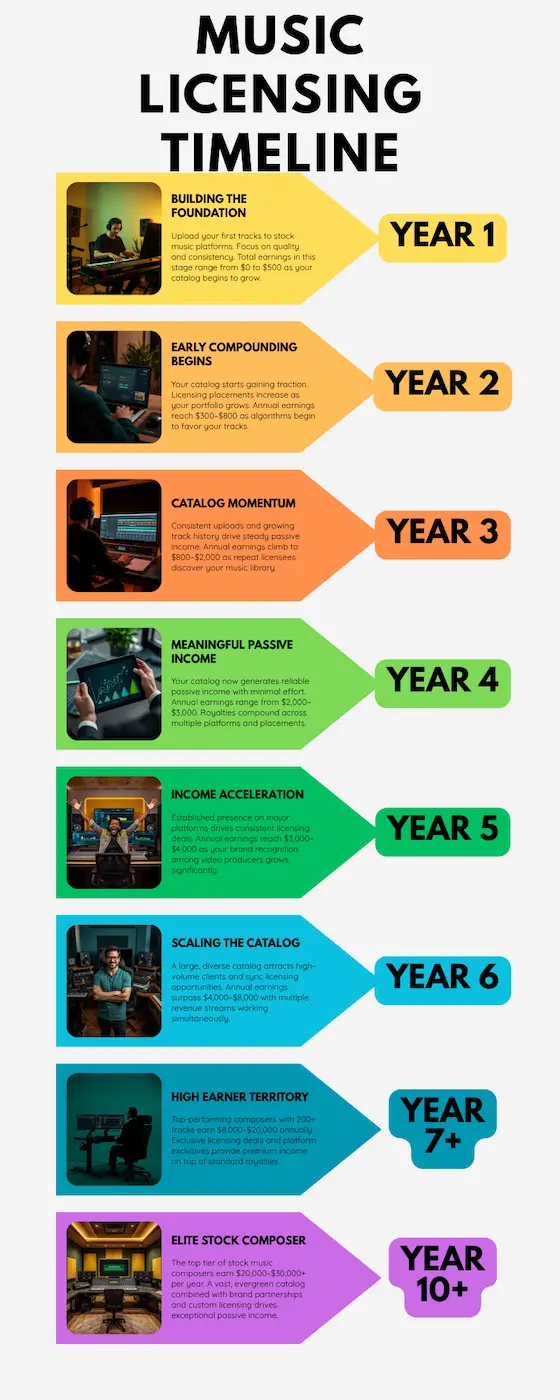
Year 1: Building the Foundation ($0–$500 total)
Your first year is almost entirely investment with minimal return. You're learning platform requirements, getting music accepted (and rejected), figuring out what metadata works, and building a catalog from scratch.
If you upload 2–4 tracks per month consistently and spend time on metadata, a reasonable Year 1 outcome is $50–$300 total across all platforms. Some composers earn more; many earn less. The ones who earn more in Year 1 are usually those who came in with professional-quality production skills and a clear understanding of the commercial market.
The composers who quit in Year 1 thinking "this doesn't pay anything" are leaving before the compounding starts.
Year 2–3: Early Compounding ($300–$2,000 year)
This is where the passive income model starts to become visible. You have 50–100 tracks across multiple platforms. Your early uploads are still selling. New uploads add to an already-earning base.
With a catalog in this range, well-tagged across Pond5, AudioJungle, and at least one other platform, $100-month is a realistic and common range for active composers.
The top end of this range ($200/month) typically requires either exceptional production quality, a focus on high-demand commercial genres, or a higher upload cadence (6–8 tracks/month). "Performance Royalties" will become a more important part of your income in future years, but they take at least a year to be paid to you, so you need to allow time for earnings to build up.
Year 4–6: Meaningful Passive Income ($2,0000–$4,000 year)
Composers who stay consistent reach this range with catalogs of 150–400 tracks. This is where stock music starts to feel like a real income stream rather than a side project.
At this stage, the income is genuinely passive — your catalog earns whether or not you're actively uploading. Adding new tracks accelerates earnings but isn't required to maintain the base. Your performance royalties will now form a meaningful portion of your income. You may also start to see meaningful income from AI dataset training
Beyond Year 5: High Earners ($4,000–$30,000 year)
The top earners on platforms like Pond5 and AudioJungle have catalogs of 500–2,000+ tracks, often with a mix of stock and sync placements, and sometimes with exclusive arrangements on premium platforms like Musicbed or Artlist.
These are outliers, not the norm. Getting here requires treating music licensing as a serious side hustle for several years. But they demonstrate the ceiling of what the model can produce. If you were to do this full time for years, uploading hundreds of songs per year, you could expect considerably more success.
What Actually Determines Your Income
Catalog Size
This is the single biggest driver of stock music income. More tracks = more chances to match a buyer's search = more sales. The relationship isn't perfectly linear (your best tracks significantly outperform the average), but more catalog is always better.
Production Quality
Not all tracks are equal. A catalog of 50 genuinely professional-quality tracks will outperform a catalog of 200 mediocre ones. Production quality affects: acceptance rates on curated platforms, search ranking on all platforms, and whether buyers choose your track over competitors.
This is where investing in your mixing and EQ skills pays off directly. See our guides on EQing piano, EQing strings, and mastering chain setup if you want to improve your production quality.
Genre Choice
Corporate and background music consistently outperforms more creative genres in raw sales volume. Cinematic music has high demand but also extremely high competition from professional film composers. Acoustic and folk is steady. Experimental is a difficult sell.
Writing music you hate just because it sells better is a recipe for burnout. The better strategy: write in genres you enjoy, but understand which of your styles has the best commercial appeal and lean into it.
Metadata Quality
A great track with poor metadata won't sell. Stock music search is keyword-driven. Buyers type "upbeat corporate background" and your track needs to appear. Spending an extra 10 minutes per track on metadata can meaningfully outperform a faster upload process.
Platform Mix
Composers on one platform earn less than those on three. Diversifying across Pond5, AudioJungle, and at least one other platform (Audiosparx, Musicbed, or similar) both increases your buyer reach and protects your income from single-platform algorithm changes.
Consistency of Uploads
Platforms reward active contributors. A steady cadence of 2–4 tracks per month over three years is far more valuable than uploading 100 tracks in one month and then stopping. The compound effect of consistent uploading is the most underappreciated factor in stock music income.
Platform-by-Platform Income Reality
Pond5
3-% royalty, self-set prices ($20–$150 typical range). At 100 tracks with a mix of price points and genres, $50–$200/month is achievable. Pond5 has been my highest-earning platform over the long term. Read the full guide to making money on Pond5.
AudioJungle
~36% royalty for non-exclusive authors. Higher buyer volume than almost any other platform, but strict curation and complex upload requirements mean a slower start. At 50+ accepted tracks in popular categories, $100–$300/month is realistic. Read our full AudioJungle review.
Audiosparx
Lower volume than Pond5 or AudioJungle, but different buyer types — more sync-oriented placements. Adds meaningful income as a third platform once you have a solid catalog. Read our Audiosparx review.
PRO Performance Royalties
Often overlooked: if your music gets broadcast publicly (TV shows, ads, radio), your performing rights organization (ASCAP, BMI) pays you performance royalties. These aren't captured by stock music platforms at all — they're paid directly to you. One TV placement can generate more than a year of stock sales.
Use the Earnings Calculator
Rather than relying on generic benchmarks, model your own income potential using our stock music earnings calculator. Input your catalog size, average price per track, and estimated monthly sales rate to project where you'll be in 12, 24, and 36 months.
The Bottom Line
Stock music composing is a legitimate income stream, but it's a slow-build business, not a quick revenue source. The composers who earn meaningful passive income treated it seriously for 3–5 years before reaching a stable base. The composers who dismiss it as "not worth the effort" usually quit within the first year.
If you're willing to play a long game — consistent uploads, quality production, solid metadata, multi-platform distribution — the passive income model genuinely works. I've seen it work for myself and dozens of composers I've spoken with over the years.
Free 5-Day Course
Start Building Your Stock Music Income — The Right Way
The free Music Licensing Crash Course is 5 days of practical lessons covering platform selection, upload strategy, metadata, and catalog building — everything you need to avoid the mistakes most composers make in year one.
Start the Free Course →No spam. Unsubscribe any time.
For the full strategic overview, read our complete guide to making money licensing stock music.
From a Frustrated Producer in a Ragtag Bedroom Studio to Major Placements on TV Earning $1,000s!
My name is Evan, and I've been making music since around 3rd grade. I'm from San Diego, California, but I've lived in Washington, DC for the last 20 years.
While I still have a full-time day job, I have created systems that have allowed me to produce dozens of songs a year in my spare time.
My songs have been on Netflix, TV shows like the 90 Day Fiance, an award-winning indie film, and NPR’s “All Thing Considered.” They've also been streamed millions of times.
In addition to being a music producer, I am passionate about teaching people how they can make professional-sounding music and earn money licensing it, all in their spare time.
Thousands of musicians, like yourself, have trusted me to guide their musical journey. My YouTube videos have been watched nearly a million times. And my story has been in Forbes, Side Hustle Nation, and the Side Hustle School.


EQ is the most essential tool you have for making music sound clean, clear, and professional. In this book you'll learn how to use the R.O.S.E. System, a simple 4-step EQ formula to help you master the world of EQ
