Best Music Libraries for Stock Music Composers (2026): Ranked & Reviewed
There are dozens of stock music libraries competing for your catalog. Most aren't worth your time. A handful are genuinely excellent, depending on where you are in your composing career and what type of music you make.
This guide ranks the best music libraries for stock composers in 2026 — based on royalty rates, submission ease, buyer volume, and real-world earnings experience. I've sold music on most of these platforms personally, and I'll tell you which ones have earned it and which ones I'd skip.
Free 5-Day Course
Not Sure Where to Start?
The free Music Licensing Crash Course covers platform strategy, catalog building, and how to actually build passive income from your music — in 5 days, completely free.
Get Instant Access (Free) →No spam. Unsubscribe any time.
Quick Comparison: Best Music Libraries at a Glance
| Library | Royalty Rate | Exclusivity | Best For | Difficulty |
|---|---|---|---|---|
| Pond5 | 50% | Optional | Beginners, all genres | Easy |
| AudioJungle | ~36% | Optional | Corporate, commercial | Hard |
| Audiosparx | Varies | Optional | Sync-oriented composers | Medium |
| Musicbed | 50%+ | Yes | Professional / cinematic | Very Hard |
| Artlist | Usage-based | Yes | High-volume exposure | Hard |
| Epidemic Sound | Flat fee | Yes | High volume, YouTube | Very Hard |
| Soundsnap | Varies | Non-exclusive | Sound design + music | Medium |
#1: Pond5 — Best for Beginners and All Genres
Royalty: 30% non-exclusive
Exclusivity: Not required
Curation: Lenient — lets the market decide
Best for: Composers at any stage
Pond5 is my top recommendation for most stock music composers, especially those just getting started. The 50% non-exclusive royalty is generous, the submission process is simple, and they accept a wide range of genres without the brutal curation standards of AudioJungle.
Since Shutterstock acquired Pond5 in 2022, composers have gained additional distribution exposure through Shutterstock's buyer network — without any change to the royalty structure.
The main limitation: Pond5 is a volume marketplace, which means pricing pressure. You're competing with thousands of composers, and buyers often sort by price. Strong metadata and a clear niche help your tracks stand out.
→ Full guide: How to make money on Pond5 | Pond5 review
#2: AudioJungle — Largest Buyer Volume, Steepest Learning Curve
Royalty: ~36% non-exclusive (scaling toward 70% for exclusive)
Exclusivity: Optional
Curation: Strict
Best for: Composers with polished, commercial production
AudioJungle has the largest stock music buyer base in the world. If your tracks get accepted and rank well, the earning potential is significant. The catch: their review process is famously difficult, the upload workflow is complex, and new authors are limited to 2 submissions per month. Note, AudioJungle is not currently accepting new composers.
I recommend AudioJungle as a second platform, not a first. Build your catalog on Pond5, understand what sells, then bring your best corporate-leaning tracks to AudioJungle once you have 30+ tracks elsewhere and a confident production workflow.
→ Full guide: How to sell music on AudioJungle | AudioJungle review
#3: Audiosparx — Best for Sync-Oriented Composers
Royalty: Varies by license type
Exclusivity: Not required
Curation: Selective but accessible
Best for: Composers seeking sync placements alongside standard licenses
Audiosparx operates differently from Pond5 and AudioJungle — it's more focused on connecting composers with sync opportunities (TV, film, advertising) rather than pure one-off license sales. This means lower volume but potentially higher per-placement value.
It's a strong third platform once you have an established catalog. The buyer base overlaps less with Pond5 and AudioJungle, which reduces cannibalization and adds meaningful income without duplicating effort.
→ Read: Audiosparx review
#4: Musicbed — Premium Sync Licensing for Established Composers
Royalty: 50%+ per placement
Exclusivity: Required
Curation: Very selective
Best for: Professional composers with high-quality catalogs
Musicbed is a premium sync licensing platform used heavily by professional video production companies, brands, and advertising agencies. The per-placement fees are significantly higher than standard stock platforms — a single Musicbed placement can earn more than dozens of Pond5 sales.
The barriers are real: Musicbed requires exclusivity (your Musicbed tracks can't be on other platforms), and their acceptance standards are high. They're looking for professional-grade, unique-sounding music — not generic corporate stock.
Once your production quality and catalog are at a professional level, Musicbed is worth pursuing. Before that, it's not accessible. Most new composers should spend 2–3 years building on Pond5 and AudioJungle before applying to Musicbed.
#5: Artlist — High Exposure, Lower Per-Track Rates
Royalty: Usage-based (flat share of subscription revenue)
Exclusivity: Required
Curation: Selective
Best for: Composers prioritizing exposure and brand over per-sale rate
Artlist operates on an annual subscription model — buyers pay a flat fee for unlimited music access. Composers earn based on how much their tracks are used relative to total usage across the platform.
The per-stream rates are low, but Artlist's subscriber base is enormous (particularly among YouTube creators and video professionals). High-performing tracks can generate substantial income from sheer volume. Exclusivity is required, which means significant commitment.
Artlist is best considered after you've established a multi-platform income base and have strong data on which tracks perform best. Committing your most valuable tracks to Artlist exclusivity without that data is premature.
#6: Epidemic Sound — Maximum Volume, Minimum Control
Royalty: Flat fee purchase + streaming-based royalties
Exclusivity: Yes — full catalog
Curation: Extremely selective
Best for: Composers willing to trade control for massive YouTube exposure
Epidemic Sound is one of the most-used music libraries among YouTube creators, which gives accepted composers enormous exposure. The trade-off: they require full catalog exclusivity (meaning your entire output goes through them, not just selected tracks), and their acceptance standards are very high.
This is an all-or-nothing model. If you're accepted and your music performs well, the income can be substantial. But giving up catalog control entirely is a significant commitment — and one that makes pivoting to other strategies much harder.
Platforms Worth Skipping
Not every library deserves your time. A few notes on common ones that consistently underperform:
Jamendo: Free music community more than a licensing marketplace. Very low commercial buyer activity.
Soundcloud: Discovery platform, not a licensing library. Not worth treating as a revenue source for stock music.
Many subscription-based "we'll submit to 50 libraries" services: Usually a waste of money. The libraries that matter have selective curation — a submission service can't get around that.
How to Choose the Right Platforms for You
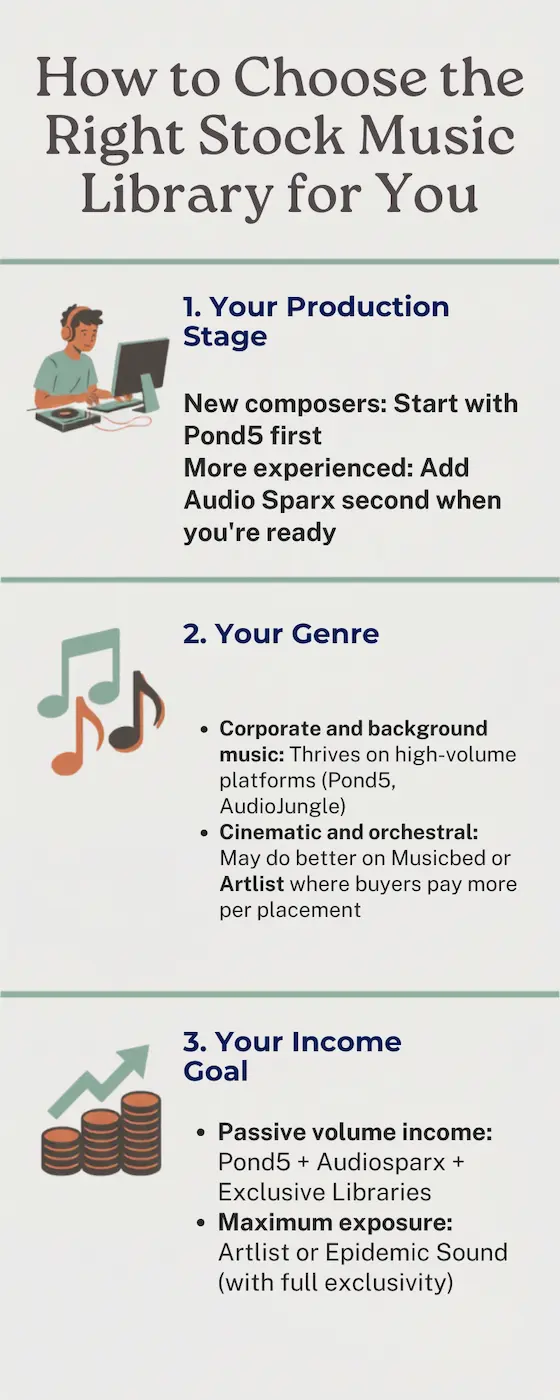
The right platform mix depends on three things:
- Your production stage: If you're new, Pond5 first. AudioJungle second when you're ready.
- Your genre: Corporate and background music thrives on high-volume platforms (Pond5, AudioJungle). Cinematic and orchestral may do better on Musicbed or Artlist where buyers pay more per placement.
- Your income goal: Passive volume income → Pond5 + AudioJungle + Audiosparx. Sync placement income → Audiosparx + Musicbed. Maximum exposure → Artlist or Epidemic Sound (with full exclusivity).
Don't try to be on every platform at once. Master two or three, then expand. See our guide to music libraries accepting submissions for submission tips for each platform.
Free 5-Day Course
Build Your Music Licensing Strategy — Free
The Music Licensing Crash Course walks you through choosing platforms, setting up your catalog, and building a licensing income stream from scratch. Five practical lessons, completely free.
Start the Free Course →No spam. Unsubscribe any time.
For the full roadmap, read our complete guide to making money licensing stock music.
From a Frustrated Producer in a Ragtag Bedroom Studio to Major Placements on TV Earning $1,000s!
My name is Evan, and I've been making music since around 3rd grade. I'm from San Diego, California, but I've lived in Washington, DC for the last 20 years.
While I still have a full-time day job, I have created systems that have allowed me to produce dozens of songs a year in my spare time.
My songs have been on Netflix, TV shows like the 90 Day Fiance, an award-winning indie film, and NPR’s “All Thing Considered.” They've also been streamed millions of times.
In addition to being a music producer, I am passionate about teaching people how they can make professional-sounding music and earn money licensing it, all in their spare time.
Thousands of musicians, like yourself, have trusted me to guide their musical journey. My YouTube videos have been watched nearly a million times. And my story has been in Forbes, Side Hustle Nation, and the Side Hustle School.


EQ is the most essential tool you have for making music sound clean, clear, and professional. In this book you'll learn how to use the R.O.S.E. System, a simple 4-step EQ formula to help you master the world of EQ
